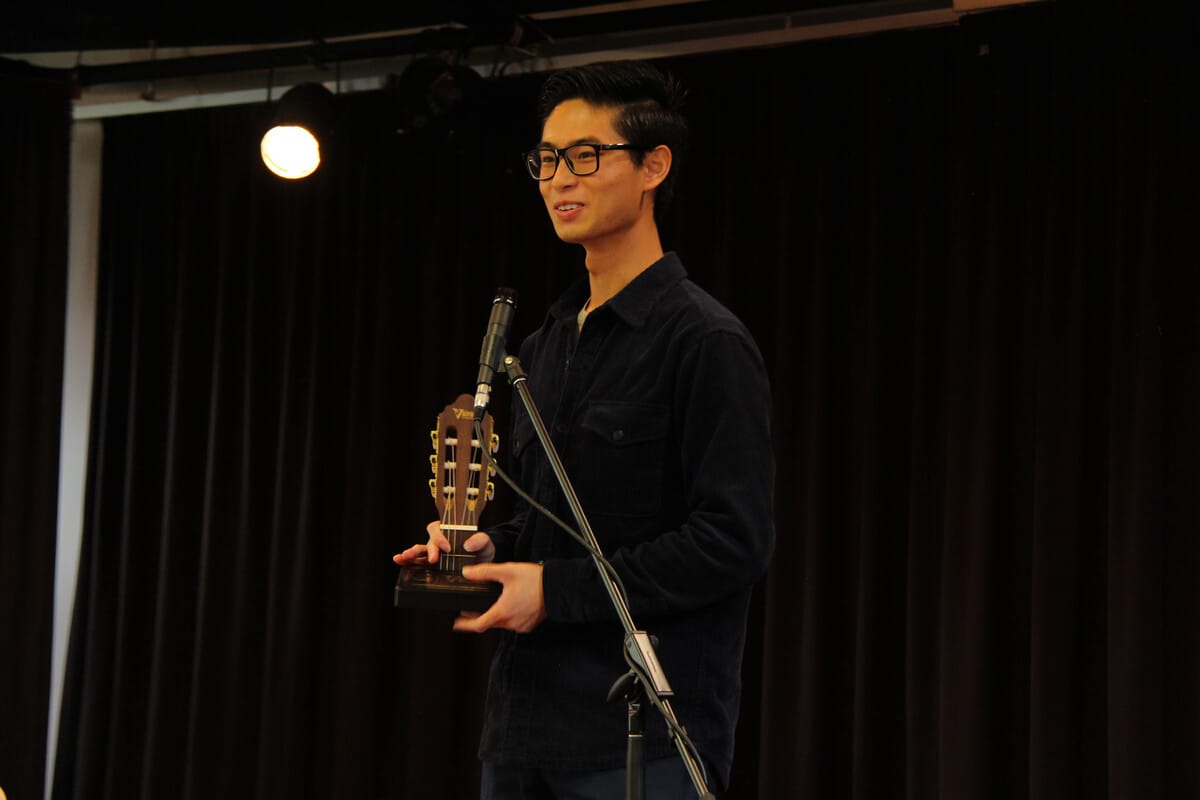


It’s been a long time since I smiled like that.
I’m a failed musician.
There are days when I’ve made peace with that. I understand that I’m part of the vast majority of musicians who try to build something meaningful out of their craft and, for one reason or another, don’t quite get there.
But there are other days when my mind drifts backwards.
I find myself replaying moments that felt like they were leading somewhere. Moments where I was convinced I was only one step away from something bigger—one opportunity, one conversation, one break that might have changed everything.
I don’t regret anything. At least, I don’t think I do.
And yet, there’s still a part of me that wonders whether things might have turned out differently if I had pushed a little harder, taken a few more chances, or simply stayed in the moment instead of stepping away from it. I wonder if I would still be on stage now.
Before I go on, I want to give a quick shoutout to the two newest members of The Offstage Sessions, the newsletter's paid tier – Kevin and David who both became lifetime members. I love you guys!
I’ll share more on what The Offstage Sessions is all about at the end of today’s newsletter.
There are more trends and changes on instagram and tiktok these days than the weather, and my girlfriend wondering what clothes to wear for a Wednesday evening dinner with her parents.
And even if you’re not on social media (serious kudos to you) I’m sure you’ve heard of the trend “2016 is the new 2026” going around.
I had to stop and think why that is. It’s not like people haven’t done throwback posts online before. It’s been going on since the birth of facebook, long before tiktok and definitely long before instagram.
But then, when I look back at 2016, it dawned on me that 2016, at least for the world, may have been the last “normal” year before shit really hit the fan.
For me, 2016 was my first year out of high school and whilst I had been diagnosed with depression the year before, I had hope that I could be a “successful musician.” I didn’t care if the trend of musicians “making it” was so low, let alone know about it.
2016 was also the last true year where I could still call up my best friends, who all still lived close by, and we’d go out for dinner, go for a long drive, singing to Disney songs, and be a public menace, honking the horn down suburban roads at 1am.
I’ll Make a Man Out of You” and “Can You Feel the Love Tonight?” were our jams.
Those really did feel like the best days of our lives.

It’s like I knew that after 2016…things would be different
It was the last year I could remember where we weren’t glued to our screens like siamese twins.
Instagram was only 5 years old, TikTok had not been invented yet, it was still cool to have Facebook, and YouTube was still a fun place to upload your videos without ever thinking it could turn into a business.
Having a podcast was considered a bit weird, with radio disc jockeys still considered kings of the digital broadcasting world.
The average fuel price per litre in Sydney was $1.10. I repeat – $1.10.
That was the price of two soft serves at McDonalds.
I guess what I’m saying is, life was alright for the world and me.
So when I think about when the world and my life truly changed, I think back to 2017.
That’s when fuel prices decided to stop being nice and rose up to an unthinkable $1.30 per litre. Gee.
In the music world, 2016 was the year that truly stopped the music. The likes of Prince, David Bowie, Glen Frey, Leonard Cohen, George Martin and George Michael all passed away. Some from old age, some from long term illness.
And if that wasn’t enough of a blow to the heart, in 2017, Chris Cornell, Chester Bennington and Tommy Page died by suicide. That was the first time I started to pay attention to the other side of the music world. The dark side. The one filled with mental illness, suicide, and artist exploitation.
And it was also the year when I took off for my first solo trip at nineteen. It was the year when I decided to “become a musician.”
I had been out of high school for two years, carrying a guitar and a quiet belief that something might happen if I just put myself in the right places.
That trip became everything I had hoped for, at least on the surface. I met many of my guitar heroes, made friendships that have lasted to this day, ran across Amsterdam in thongs—flip flops, not the other kind—and, for about fifteen minutes, felt like a rockstar at Philadelphia airport.

You know you’re a true musician when you have to cram all your gear + band into a tiny car
Like most young musicians, I spent that time asking questions.
I wanted to know how people had made it, who had inspired them, what their first real opportunity looked like, and whether there was a moment where everything changed. I busked on the streets, played open mic nights in small pubs, and recorded videos with other guitarists, quietly hoping that one of those collaborations might be the thing that pushed me forward.
On the final leg of that trip, I found myself at the Canadian Guitar Festival, held at Loughborough Lake Holiday Park.
I had gotten there by hitching a ride with someone I barely knew—a man I had met only days earlier at a workshop in Toronto. It went against everything my parents had ever taught me, but at the time it felt like the kind of risk that musicians were supposed to take. Besides, he wanted to go as well.

It’s okay, we were matching so we became instant bros.
The festival itself wasn’t one of the major global events people talk about. It wasn’t Coachella or Montreux. But to me, it carried weight. It was a place where artists I admired had once stood, where careers had quietly begun.
I didn’t go there with any real expectation of winning anything. I simply wanted to perform, to have a go, and to give people a good time. Being the only Australian there, I even thought it might be fun to make a joke about how much I loved wearing thongs.
But when the time came to step forward, I didn’t.
I told myself I was too tired.

I love me thongs
Instead, I sat back and watched.
Every performer who got up had something about them—something distinct, something worth paying attention to. And as I sat there, I couldn’t shake the feeling that I had just let something pass me by. Not in a dramatic, life-ending way, but in a quiet, almost imperceptible way that lingers longer than it should.
At the time, I explained it away as homesickness.
But looking back now, nearly a decade later, I don’t think that’s what it was.
I think it was one of the first real signs that something deeper was going on.
That trip lasted close to three months, and while there were moments of excitement and movement, there were also long stretches where I felt completely detached from everything around me.
There were days where I would stay in my Airbnb, doing nothing in particular, just staring at my phone or lying in bed. It wasn’t the kind of tiredness that comes from travelling. It was something heavier, something harder to explain.
I didn’t want to go home, but I didn’t want to go out either.
It didn’t seem to matter which city I was in. Amsterdam, Haarlem, Bristol, Liverpool, Southampton, Los Angeles, Portland, San Francisco, Vancouver, Toronto—they all blurred into the same emotional landscape. Each new place came with the same underlying feeling of numbness and distance.
That feeling had been there before I left, and it followed me throughout the trip. When I returned home, it stayed.

I have to admit, Toronto is a beautiful city and beats Vancouver
It’s a feeling I still recognise today.
There are days where nothing feels particularly exciting, even the things I once loved. I care deeply about the people in my life, and I enjoy being around them, but there are times where I don’t have the energy to show up in the way I would like to.
And even now, I still have moments where I feel the urge to leave everything behind and get on a plane, as if a change in location might somehow reset something internally.
The difference is that now, I understand it better.
I see a therapist regularly. I’m on medication that helps me sleep and gives me just enough space to make sense of the thoughts that would otherwise overwhelm me. I make an effort—however imperfect—to open up to the people closest to me.
None of that existed when I was nineteen.
Back then, I did what I thought I was supposed to do.
I kept pushing forward with music.
Like most musicians, my experience was filled with more difficult days than good ones. There were more gigs that didn’t go well than ones that did, more songs that fell flat than ones I was proud of, and more moments of playing “for exposure” than being properly valued for my work.
But I kept going, because that’s what I believed an artist was meant to do.
When performing and songwriting stopped feeling sustainable, I shifted into teaching and eventually built a music school. Over time, I taught more than five hundred students across Sydney. In many ways, that work kept me afloat, both financially and emotionally.
And yet, even with all of that, something still felt off.
Because whenever a real opportunity came along—something that might have pushed things further—I hesitated.
Competitions I had a genuine chance of doing well in.
Performance opportunities that could have opened new doors.
Even the chance to study abroad, which only required me to follow through on something I was already capable of doing.
Time and time again, I stepped back.
And each time, I told myself the same thing.
I was too tired.
For a long time, I believed that explanation.
I blamed the stress, the pressure, and the uncertainty that comes with trying to build a life in music. And while those things were real, they weren’t the full picture.
There was something underneath all of it—something I had ignored for years.
It wasn’t the external circumstances.
It was what was happening inside my own head.
Because as much as I believed in myself as a musician, there was another part of me that felt completely inadequate outside of it.
A lot of my drive came from wanting to prove people wrong—friends, family, anyone who had questioned whether music was a viable path. Even when those concerns came from a place of care, they still stayed with me.
And over time, every opportunity became loaded with meaning.
If I took it, it had to prove something.
If I didn’t, it felt like I was confirming every doubt that had ever been placed on me.
That kind of pressure doesn’t always show up as ambition.
Sometimes, it shows up as avoidance.
As hesitation.
As telling yourself you’re too tired, when in reality, you’re overwhelmed by something you don’t yet understand.
And maybe that’s what I’m only beginning to come to terms with now.
So I’ll leave you with this:
I wanted to share these thoughts because I have a feeling a lot of you—like many musicians—feel that your careers haven’t quite panned out the way you hoped. I certainly feel that.
You might think about the missed opportunities.
You might find yourself asking, “what could’ve been?” if you had done something differently.
The one thing we can’t change is the past. You already know that.
But there’s a piece of advice I was given back in 2017 that I never fully understood… until now:
“The future hasn’t happened yet. It’s yours to create.”
It’s made me realise how much of my time has been spent not just dwelling on the past, but stressing about the future as well.
2016 was probably the last year I remember feeling… normal.
Every year since then has felt more like 2017.
Full of stress, pain, overwhelm, disappointment, grief.
There were years where I thought about ending my life.
I’ve lost both my grandmas.
I’ve had three seizures.
But alongside all of that, there have been moments I can’t ignore.
I built a music school and taught over 500 students across 10 years. Some of them I still keep in touch with. Some of their parents treat me like their own.
I met my girlfriend, who has made me feel more loved and appreciated than I ever thought I could be—and someone I’ve been able to build a home with.
I have five friends who feel more like brothers.
And now, I’m doing something that feels more important than getting up on stage and playing a few songs. At least for me.
So for everything I feel like I’ve lost, I’ve also gained something. Not something that replaces it—but something that reminds me that even in the worst moments, there’s still something there.
A moment where I can smile.
And maybe, in 2036, I’ll look back at this version of myself and think:
“Things turned out okay.”
Thank you so much for joining me for today’s newsletter. It shows me that not only are you willing to support me and I really do appreciate it.

And if you found today’s newsletter helpful for your own mental health journey as a musician, I’d love it if you could share it with a friend or someone you know who’s struggling at the moment.
The more you share, the more we can help more and more people who are going through something similar, and help musicians find ways to express their pain without having to hide behind their music.
And If you’re a long time reader and my newsletter has helped you in your mental health/music journey, please consider upgrading your subscription which costs less than two coffees a week.
If you decide to upgrade, you’ll get an exclusive first look at the full drafts where your input, questions and feedback will shape the final outcome of each newsletter.
You’ll also get access to audio versions of each newsletter, done by me, not an AI bot, and podcasts where I have conversations with fellow musicians and friends about their mental health challenges as musicians.
You’ll get also get access to audio versions of each newsletter, done by me, not an AI bot, and special video podcasts where I have conversations with fellow musicians and friends about their mental health challenges as musicians.
But even if you’re a free subscriber, you’re already supporting me, and I’m grateful for that.
So until then, take care of yourself.
-Brian a.k.a The Mental Musician

Join The Offstage Sessions
If you’ve ever felt like no one truly understood what you were going through as a musician, this is where that changes. The Offstage Session isn’t just extra about content. It’s a space where I show up as the kind of bandmate who actually listens, offering real support and sharing the harder parts of my own struggles, the parts I don’t always share publicly, so you don’t have to carry it alone
Join TodayHere’s what you get when you join The Offstage Sessions:
- Access to audio recordings of every newsletter (recorded by the real version of me, no AI)
- Early access to every YouTube video and podcast episode
- You'll be credited as a direct producer of each newsletter
- I’ll send you a personal email each month to check in and see how you’re doing
- An additional newsletter per month where I share even deeper and personal stories
